Carry-On Culture: Haaland, Hermès and the New Athlete Uniform
At the World Cup, Erling Haaland's collection of rare bags became almost as closely watched as his football. But the fascination was about more than price or celebrity. It revealed how fashion's relationship with sport has moved from dressing the team to expressing the individual.
Before Erling Haaland touched a ball at the World Cup, he had already made an entrance.
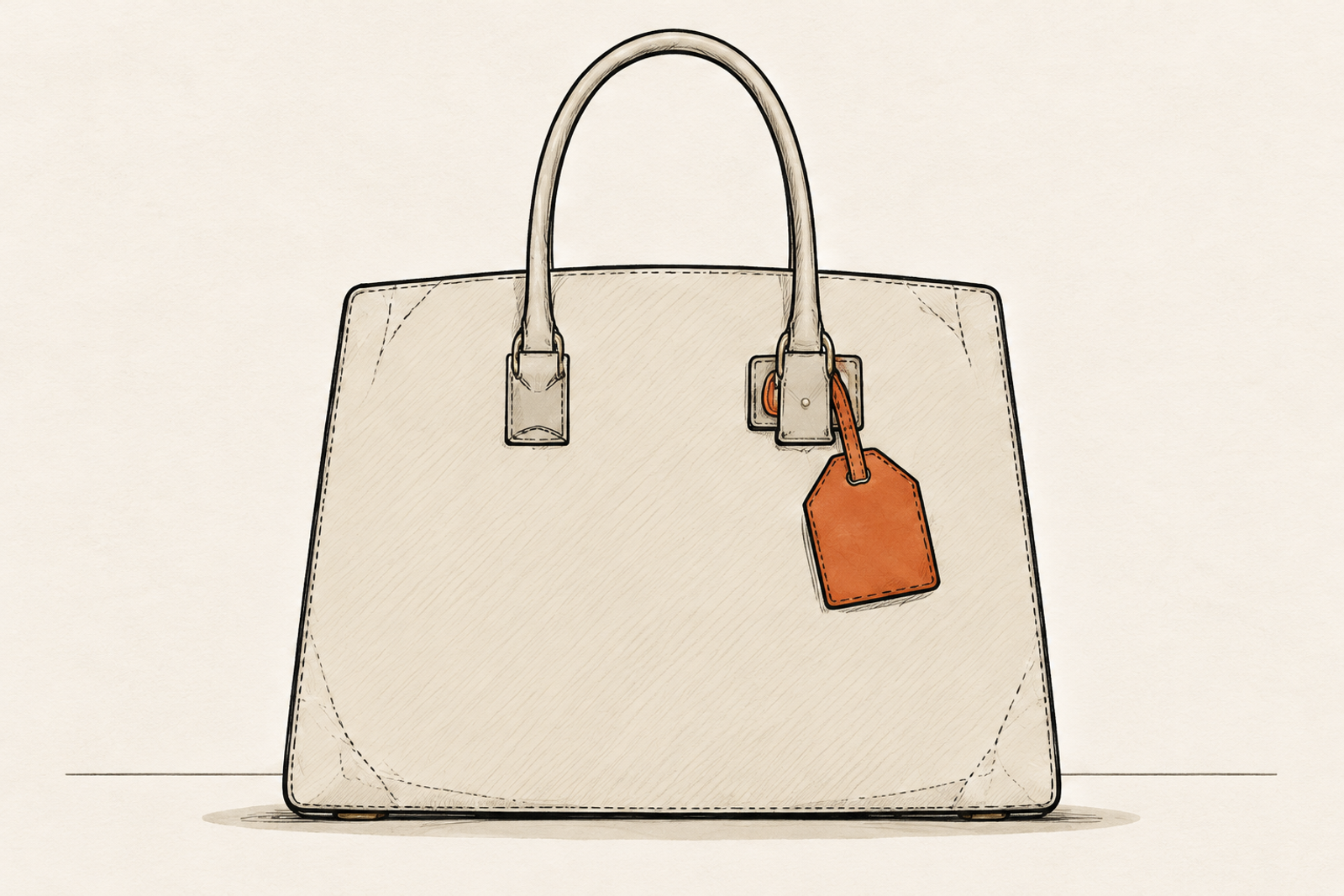
Stepping from Norway's plane in the prescribed navy team uniform, the striker carried something altogether less standard: an oversized Hermès Haut à Courroies in the limited-edition Endless Road design. Against the controlled sameness of the national-team wardrobe, the bag was unmistakably personal—structured, rare and decorated with a landscape rendered in leather marquetry.
It was not the only exceptional bag to accompany him through the tournament. Haaland was subsequently seen with several variations of the Haut à Courroies, or HAC, alongside pieces from other luxury houses. Fashion publications began cataloguing the collection. Social media studied the colours and dimensions. Resale estimates were reported, repeated and disputed, occasionally with the intensity usually reserved for transfer fees.
The exact value is almost beside the point. Public estimates of the collection vary considerably, and there is no publicly confirmed inventory. What was visible, however, was enough to turn Haaland's luggage into one of the World Cup's unexpected continuing stories. GQ devoted an article to the collection, while coverage across fashion and mainstream media considered not only the bags themselves, but what their prominence suggested about luxury and masculinity.
The tournament is over, but the image remains useful. Haaland's bags belonged to a much larger transformation: the athlete's arrival has become a performance of its own.
The space between uniforms
During a match, footballers are dressed to be read collectively. Their shirts communicate country, club, sponsor, position and allegiance. Individual differences are necessarily limited.
The journey to the stadium or hotel offers something else.
Airport terminals, hotel entrances and stadium tunnels have become transitional stages: not quite the field, but no longer private. Every arrival can be photographed, circulated and analysed before the formal action begins. Basketball has its tunnel walk; football has the team bus and airport arrival. Both have created a new category of sports imagery in which clothes help introduce the athlete before competition does.
Against this background, a bag is particularly effective. It can be carried while the athlete remains in official team clothing. It does not interfere with the uniform, yet it interrupts its sameness.
That was the visual logic of Haaland's World Cup appearances. Norway supplied the collective identity; Hermès supplied the individual signature.
His choice was also more historically appropriate than some of the "Birkin" shorthand surrounding it suggested. The Haut à Courroies is Hermès's first bag, originally designed to transport saddles and riding boots before developing into a travel piece. Its high, capacious construction still carries that utilitarian origin. Hermès describes it as a bag that moved from equestrian equipment into modern travel.
On Haaland—a 1.95-metre athlete travelling between countries, hotels and stadiums—the scale made sense. It did not resemble a delicate accessory added for effect. It looked like luggage, but luggage elevated into an object of design, rarity and collecting.
Norway supplied the collective identity; Hermès supplied the individual signature.
Fashion did not arrive at sport yesterday
The meeting of fashion and athletic life is far older than the social-media tunnel.
Modern fashion repeatedly borrowed from clothes designed for movement: tennis whites, riding jackets, ski trousers, polo shirts and varsity jackets. Some early sportswear innovations came from athletes themselves; others came from designers responding to the freedom demanded by sport.
Emilio Pucci's career, for example, began on the ski slopes in the late 1940s. His streamlined ski clothes helped introduce a new vision of movement, colour and modern resort life, before the house expanded into the printed fashion for which it became famous. Pucci's own history dates the foundation of the brand to 1947 and its beginnings to the Swiss slopes.
It would be too simple to appoint one designer or partnership as the definitive "first" instance of fashion dressing a team. Military tailors, department stores, sports manufacturers and fashion houses all contributed to the evolution of ceremonial and competition dress. Different sports also developed at different speeds.
What did become increasingly clear during the twentieth century was the distinction between two wardrobes.
The technical uniform existed to perform. The ceremonial wardrobe existed to represent.
This second category—the suits worn on official journeys, the coats used at opening ceremonies, the coordinated clothes for public appearances—gave fashion houses an opportunity to shape how athletes appeared as a group. Designers were no longer simply borrowing the codes of sport. They were helping teams construct an institutional image.
The Olympic parade became one of the most visible examples. Ralph Lauren began dressing the United States Olympic and Paralympic teams for the Beijing Games in 2008 and has continued across successive Games; Milano Cortina 2026 marked its tenth consecutive Olympic and Paralympic Games outfitting Team USA. The clothes translate a national idea—classic American sportswear, ceremony and optimism—into a collective wardrobe. Ralph Lauren records the beginning of the official relationship in 2008.
In Italy, EA7 Emporio Armani has supplied the Olympic and Paralympic teams since London 2012. For Milano Cortina 2026, the house created an extensive white wardrobe encompassing parade clothing, technical pieces, footwear and luggage. It was fashion operating not as decoration, but as a complete system of national presentation. The Italian Olympic Committee details the Milano Cortina collection and the partnership's history.
Today, this model is established throughout professional sport. The sportswear company makes the match kit; the fashion house often defines what happens around it.
Louis Vuitton currently dresses Real Madrid's men's and women's football teams and its basketball team for travel and institutional occasions. The wardrobe includes tailoring, shoes, accessories and luggage—the complete visual language of arrival. The partnership was announced in June 2025.
Giorgio Armani created Juventus's formal wardrobe for the 2025–26 and 2026–27 seasons, using the house's midnight blue, relaxed construction and coordinated accessories for official off-pitch occasions. Juventus describes the collaboration as the club's first formal wardrobe by Giorgio Armani.
AC Milan's continuing relationship with Off-White goes further into streetwear and contemporary culture. The label became the club's official "Style and Culture Curator" in 2022, supplying clothes to the men's and women's teams, and the partners released another capsule collection in April 2026. Rather than presenting the footballer only through traditional tailoring, it places the club inside fashion's current conversation about graphics, music, youth culture and identity. AC Milan's 2026 announcement confirms the partnership's continuation.
These arrangements are commercial, certainly. But they also express a deeper compatibility. Sports clubs and fashion houses both build communities around colour, symbols, heritage, ritual and belonging. Both ask people to wear an identity.
When a fashion house becomes part of the club
No relationship illustrates this more completely than Giorgio Armani's involvement with Olimpia Milano.
It began not with a superficial capsule collection, but with support at a moment when the basketball club needed it. The newly created EA7 sports line became connected with Olimpia in 2004. Four years later, Armani became the club's sole owner.
Under that ownership, the fashion name was not simply placed beside the team's. Olimpia entered what Armani's official history calls the "Armani world," with EA7 serving as title sponsor. The club became a sporting expression of the house, while remaining an institution with its own history, supporters and famous red-and-white identity. Armani's account of EA7 identifies Olimpia as the fullest expression of the brand's relationship with sport.
For Giorgio Armani, who died in September 2025, the commitment was personal as well as corporate. He attended games, followed the team closely and participated in its emotional life. A recent Olimpia publication recalled that supporters regularly saw him at matches, accepting photographs and handshakes and sharing their celebrations. It also described his involvement as having rescued the club first through sponsorship in 2004 and then through ownership in 2008. Olimpia's own history records the depth of that involvement.
This is what separates the case from an ordinary endorsement. Armani did not merely decide what the players would wear when they arrived. He helped ensure that there would still be a team arriving.
Since his takeover, Olimpia has won multiple Italian championships, cups and super cups. Yet the relationship's significance cannot be reduced to trophies. It connected two Milanese institutions and two forms of disciplined performance. The precision of tailoring and the precision of elite basketball were presented as different expressions of the same values: preparation, restraint, consistency and attention to detail.
The arrangement also reversed fashion's customary relationship with sport. Usually, a house borrows athletic energy to make itself feel faster, younger or more accessible. Through Olimpia, Armani took responsibility for the sporting institution itself.
From the team wardrobe to the personal collection
The historic designer–team partnership was built around unity. Its purpose was to make athletes look like a coherent delegation or club.
The present fashion moment adds the opposite desire: distinction.
Today's leading athletes operate simultaneously as team members and independent global figures. Their audiences may follow them across clubs, leagues and countries. The player's personal identity therefore has value beyond any single uniform.
A bag is unusually well suited to communicating that identity. Watches often disappear beneath sleeves. Cars remain outside the terminal. Much of an outfit can be hidden by compulsory team clothing. A large bag stays visible in the hand and appears in almost every arrival photograph.
It can also suggest taste rather than straightforward expenditure. A recognisable logo communicates wealth, but a discontinued colour, archival model or unusual construction implies knowledge. Collecting creates a story: the audience can compare one appearance with the next and recognise a preference developing over time.
Haaland's repeated choice of the HAC made his collection feel more specific than a sequence of random luxury purchases. One rare bag might be a styling decision. Several versions of the same historic form begin to look like connoisseurship.
Other players contributed to the wider World Cup bag conversation, including athletes carrying pieces by Dior, Chanel, Louis Vuitton and Hermès. But Haaland became its central figure because the collection was both consistent and unexpected.
The masculinity question
Some of the reaction arose from a stubborn cultural assumption: that a handbag requires explanation when it is carried by a man, particularly by a man whose public image is built around physical strength.
Haaland disrupted that assumption without appearing to make a campaign of it. The bags did not soften his sporting identity or contradict it. They simply became part of it.
The shirt tells us whom the player represents. The object carried beside it tells us who the player wants to be.
The HAC's own history makes the gendered surprise especially ironic. It began as equipment for transporting riding gear. Its contemporary prestige cannot erase its original practicality. Calling it a handbag, a travel bag or a Birkin-adjacent collectible changes the cultural response more than it changes the object.
This is why the story reached beyond fashion enthusiasts. It exposed how quickly ordinary objects are assigned gender—and how easily a sufficiently confident wearer can unsettle the assignment.
The sight of one of football's most physically imposing forwards carrying an elaborate Hermès bag made the accessory look less restricted, not the athlete less masculine.
The unofficial campaign
There is no need to assume that every appearance was coordinated with a brand. Unless a commercial relationship has been publicly announced, the simplest description is the safest: Haaland owns and carries the bags.
Yet the resulting attention demonstrates why athletes have become such powerful fashion media.
A formal campaign declares itself immediately. An airport photograph feels observational. It allows an object to appear inside the athlete's real routine, even when that routine is taking place beneath dozens of cameras. The audience encounters the product as a personal possession before considering it as marketing.
For Hermès, the World Cup imagery connected a historic travel design with one of the world's most recognisable contemporary travellers. For Haaland, it created a layer of personality that match statistics could not supply. Neither effect required a slogan.
Fashion once dressed the team so that its members would look unified. It now also helps the athlete remain recognisable inside that unity.
The shirt tells us whom the player represents. The object carried beside it tells us something—carefully selected, partly performed and perhaps genuinely revealing—about who the player wants to be.
That is why Haaland's Hermès collection is worth discussing after the final whistle. The bags were not a distraction from the World Cup. They were evidence of what modern sport has become: competition, entertainment, commerce and personal theatre unfolding at the same time.
On the pitch, the uniform remains compulsory.
Off it, the real contest may begin with the arrival.